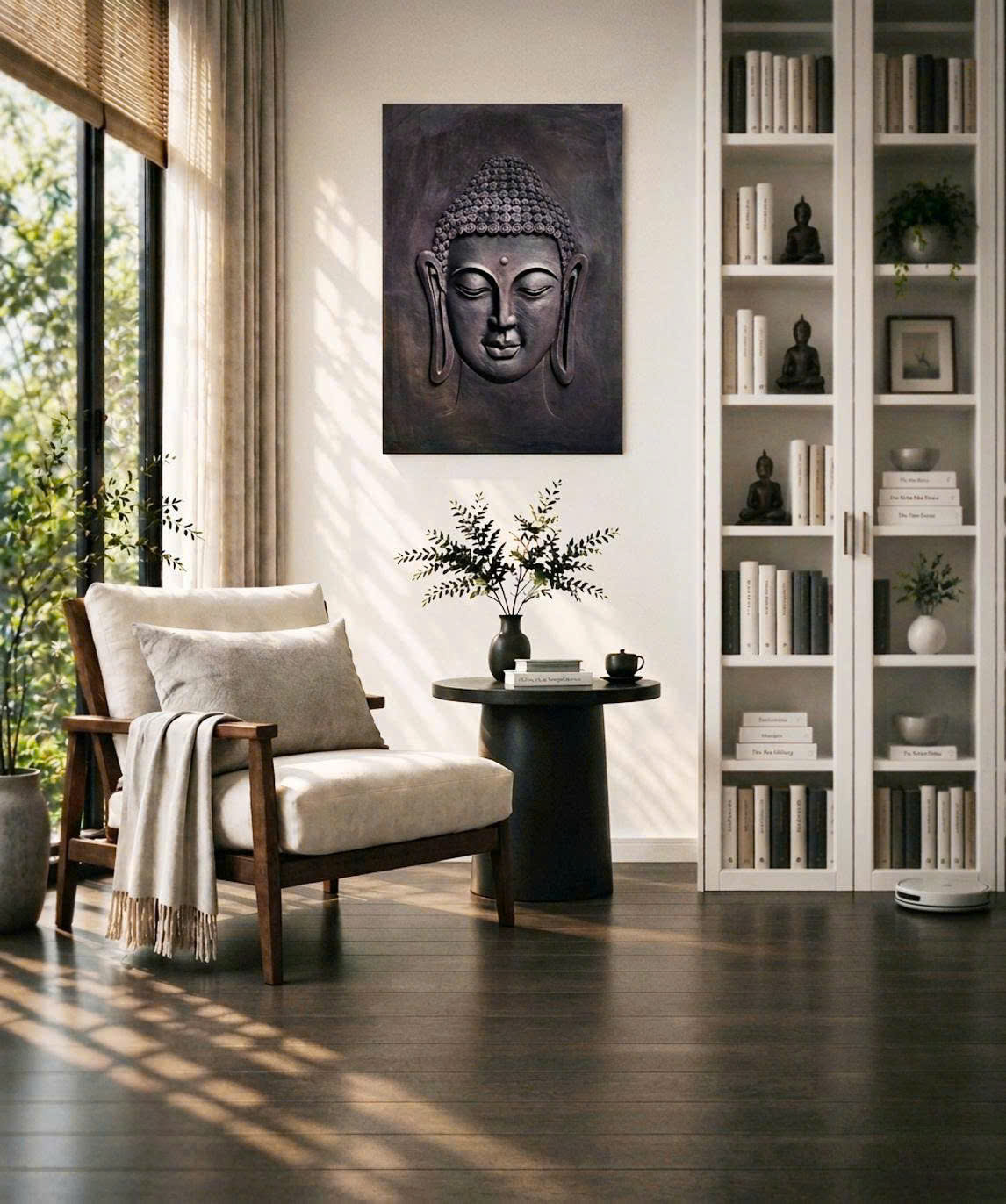


Since ancient times, Eastern Feng Shui has embodied profound ideas about philosophy, culture, and spiritual life. Through concepts such as Yin and Yang, the Five Elements, Li Qi, orientation, landform, and cycles of time, Feng Shui explores the relationship between people and their living environment, seeking balance, auspiciousness, and harmony among human beings, space, and nature.
Over thousands of years, Feng Shui has developed into many schools and methods. Their approaches may differ, yet behind these systems of thought lies a very natural human desire:
To live better within the very space we call home.
The Home and the People Who Live Within It
Every home is connected to a person or a family.
For most of us, a home is a major asset, built through many years of work and accumulated resources. Acquiring a home is rarely easy; changing it when its internal or external conditions are no longer suitable can be even more difficult.
According to traditional Feng Shui, every house also has its own “fortune cycle” or energetic character. Its form, structure, orientation, surrounding environment, and the period in which it was built all contribute to its particular qualities. In the traditional Eastern view, the fact that a person or family comes to own, inhabit, and remain connected to a particular home may itself be regarded as part of yuanfen — the circumstances and affinities that bring people and places together.
A home with favorable Feng Shui is traditionally believed to provide supportive conditions for those who live within it. Conversely, a house with unfavorable characteristics may present certain difficulties, even when the occupants themselves are passing through a relatively favorable period in life.
Yet architecture has a very practical reality:
Not everything can be changed.
The orientation of a house, the shape of the land, the positions of doors, stairs, bedrooms and kitchens, the structural system, nearby roads, or neighboring buildings may already be fixed. Some things can be altered, but others must simply be accepted because of financial, technical, or practical limitations.
This is especially true in densely populated cities, where even a small open space can be difficult to obtain. A wall may not be removable. Another window may be impossible to create. A view may simply be beyond our control.
Perhaps this is why people have long searched for different ways to adjust, supplement, and bring greater harmony to the environments in which they live.
And art possesses a very particular ability:
It can transform the way a space is experienced without necessarily changing the physical structure of that space.
Within the modest scope of this article, I do not presume to address the immense worlds of either art or Feng Shui. I would simply like to reflect on paintings and the art of placing them from the perspective of Feng Shui.
A Vast World
The appreciation and collecting of paintings is, in itself, an immense world.
To truly understand and experience a work of art requires more than knowledge of painting, culture, and artistic traditions. It also calls for experience, sensitivity, and deeply personal emotional responses. Two people may stand before the same painting and discover entirely different stories within it.
The art of placing paintings according to Feng Shui likewise contains many concepts, principles, and interpretations. Here, I would like to consider only a few fundamental perspectives on choosing and positioning paintings within a living space.
Because once a painting enters a home, it no longer exists by itself.
It begins a relationship with the wall, the light, the surrounding objects, the orientation of the house and, most importantly, the people who live with it every day.
Perhaps, then, before asking whether a painting has “good Feng Shui,” we might begin with a simpler question:
What will this painting bring into our living space?
1. The First Thing a Painting Brings Is Emotion
Before a painting is associated with Wood, Water, Mountain, or any other Feng Shui meaning, it is first and foremost an image that someone will see every day.
A work depicting sorrow, darkness, loneliness, violence, or unease may create a sense of heaviness when it remains in a space for a long time. This can be particularly significant when it is placed somewhere we see frequently — a living room, bedroom, or shared family space — where the emotions evoked by the image gradually become part of everyday experience.
Conversely, a bright and life-filled painting that evokes peace, openness, or positive emotion can make a space feel more pleasant and alive.
We may not always consciously recognize these influences.
A painting can remain before our eyes every day for months or years. Its imagery, colors, and emotional atmosphere gradually become a familiar part of our environment.
Modern psychology and neuroscience increasingly reveal that human beings do not experience their surroundings solely through conscious thought. Light, images, colors, sounds, and many other environmental stimuli are received and processed through extraordinarily subtle biological mechanisms, extending down to the cellular level. Recent scientific discoveries about how cells and their proteins respond to signals from the environment are helping us understand processes that people in earlier times could often experience only without conscious awareness.
This does not mean that modern science proves the theories of traditional Feng Shui. Yet the two perspectives seem to meet at one intriguing point:
The environment in which we live every day is not entirely neutral to our inner life or to the responses of our bodies.
At its simplest level, therefore, choosing a painting is also choosing something of the emotional atmosphere we wish to have around us.
2. Mountain and Water — When a Painting Opens Another Landscape
In residential Feng Shui, Xuan Kong Flying Stars (Flying Star Feng Shui) is one of the widely practiced schools today. It considers a building not only in relation to orientation, spatial conditions, and other relevant factors, but also in relation to time and changing cycles of Qi.
Within this system, Mountain and Water — Shan and Shui — hold particular importance.
In a broad sense, Water is often associated with movement, work, career, and wealth, while Mountain is more closely associated with people, health, stability, growth, and the continuation of generations.
But there are always limitations between theory and the reality of an existing home.
A favorable sector might ideally benefit from openness, activity, or an appropriate Water element, yet in reality that location may be occupied by a solid wall. Behind it may stand a neighboring house or a structural element that simply cannot be altered.
We cannot create a river behind a wall.
Nor can we build a mountain outside a window.
Yet a suitably chosen large painting, combined thoughtfully with lighting and interior composition, can offer that part of the home a different and more positive visual landscape.
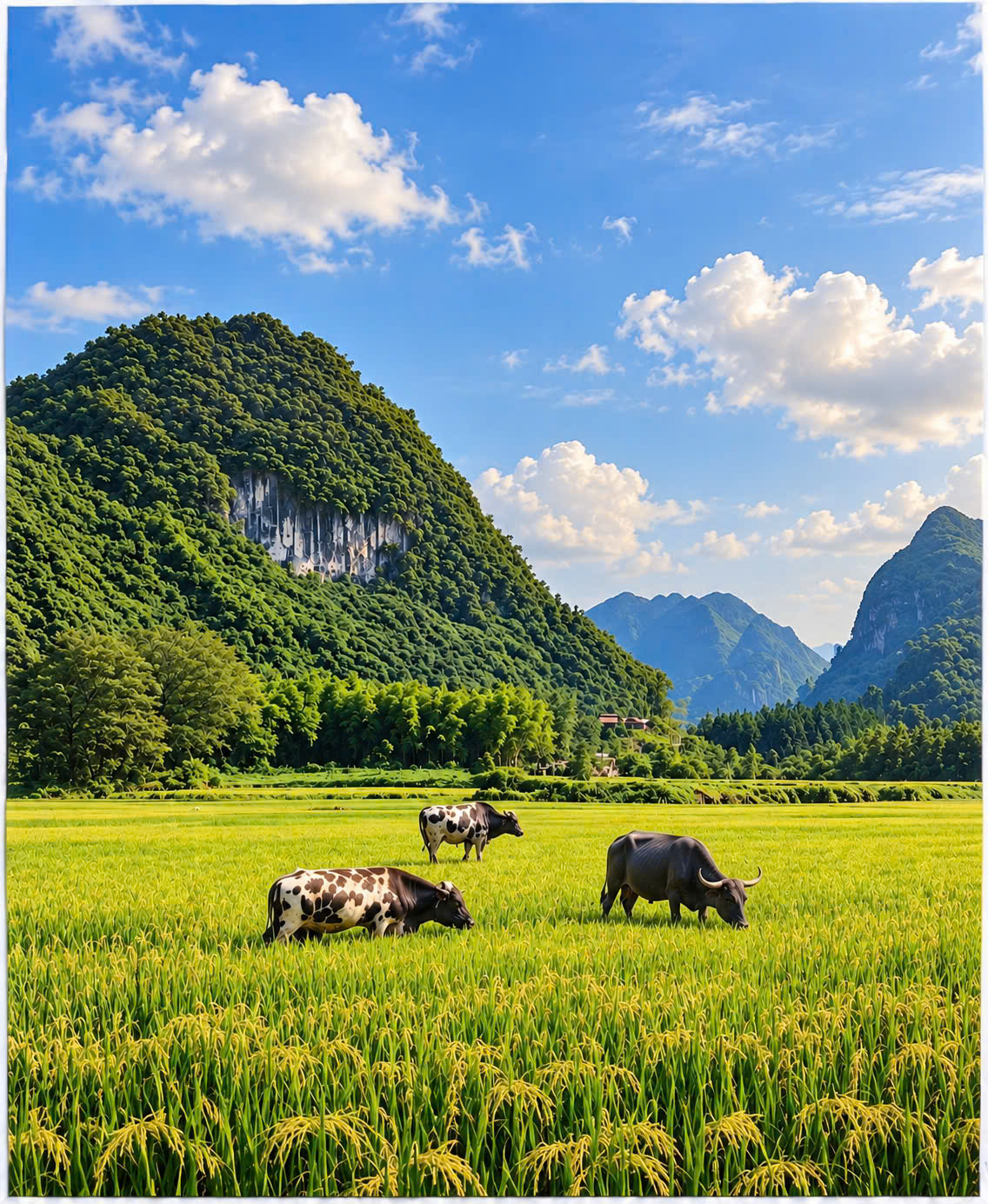
It may be an open sea, a river, a lake, or a waterfall. It may also be a mountain or a range of green, flourishing hills.
A painting can open a landscape where the physical architecture does not allow us to create one.
This is one of the qualities that makes art so interesting within architecture.
Architecture establishes relatively fixed boundaries; art gives us another way to continue our dialogue with those boundaries.
According to Feng Shui principles, however, Mountain and Water should not be used indiscriminately.
A Mountain image should convey an auspicious form — stable, life-filled, and reassuring.

Water should appear beautiful, bright, open, and alive.

A flourishing Mountain-and-Water painting placed where it is truly appropriate can be like adding embroidery to fine brocade: when a location is already favorable, the right imagery, scenery, and light can further enhance what is already good.
But the opposite also deserves consideration.
If a sector associated with people is already regarded as unfavorable and Mountain is then strongly reinforced there, according to the logic of this system, it may sometimes strengthen precisely what is undesirable. Likewise, Water does not automatically create wealth simply because water is traditionally associated with prosperity.
Where Mountain should be placed, where Water should be placed, and whether either should be strong or subtle, still or active, depend upon the characteristics of the house, its sectors, and its time cycle.
This is the distinction between hanging a Mountain-and-Water painting because we enjoy it and using Mountain and Water according to Feng Shui principles.
For in Feng Shui:
Something considered beneficial does not necessarily remain beneficial wherever it is placed.
3. When a Painting Relates Not Only to the Home, but Also to the Person
If Mountain and Water lead us to consider the house and its spatial orientation, another perspective begins with the person who actually lives there.
In traditional Eastern destiny studies, a human life is understood as passing through changing cycles of strength and difficulty. Some periods may be favorable, while others are traditionally regarded as less supportive — for example, certain zodiac years, unfavorable major cycles, years that conflict with one's birth sign, or combinations of the Heavenly Stems and Earthly Branches considered inauspicious within a particular system.
During such periods, alongside other traditional practices, paintings are sometimes used as an additional means of moderating unfavorable influences or providing symbolic support to the people living in the space.
Such applications may begin with relationships such as Liu He (Six Harmonies) and San He (Three Harmonies), together with the generating and controlling relationships of the Five Elements (Wu Xing). From there, appropriate imagery may be selected and its position within the home carefully considered.
But the subject depicted in the painting is not the only question.
What does that image represent?
What is its relationship to the Five Elements?
How does it relate to the person for whom it is intended?
And, equally important:
Where will it be placed?
This is a relatively sophisticated use of imagery within Feng Shui and should not be reduced to the idea that one simply chooses an animal considered “compatible” with one's zodiac sign and hangs it somewhere in the house.
The use of harmonic relationships and Five Element principles depends upon many other factors and requires a reasonable understanding of the particular system being applied, or careful consideration by someone with appropriate expertise.
Yet beyond all these interpretations lies another, deeply human dimension.
During difficult periods of life, an image that is beautiful, graceful, full of vitality, and rich in positive meaning may quietly remind us of hope, peace, and the better things toward which we are still moving.
Whether interpreted through traditional harmonies, the Five Elements, or simply through personal belief and feeling, behind these symbols lies a very natural human wish:
To create an environment in which we feel supported and able to hold on to hope.
4. Paintings as a Way of Supporting One's Natal Constitution
Traditional Eastern destiny studies often refer to the saying:
“First Destiny, second Fortune, third Feng Shui, fourth accumulated virtue, fifth learning.”
It is an old way of describing five influences believed to shape the course of a human life.
First comes Ming — Destiny.
Ming refers to what a person receives at birth — the time of birth, the circumstances into which one is born, and other fundamental conditions one has little or no ability to choose. It is therefore regarded as foundational and particularly difficult to alter.
After Ming comes Yun — the cycles of fortune.
Life rarely remains continuously favorable or difficult along a single straight line. There are good periods, ordinary periods, and periods of greater difficulty.
In the traditional view, understanding these cycles is not about attempting to defeat fate. Rather, it is about recognizing when to move forward, when to slow down, and when a particular moment may be more appropriate for an important decision.
Third comes Feng Shui — the environment in which we live and interact every day.
If Ming is largely beyond our ability to change, and Yun changes with time, then our living environment remains one of the areas in which we still have some capacity to make adjustments.
From this arises another application of paintings in Feng Shui: using imagery, color, and Five Element qualities to support elements believed to be lacking or insufficiently balanced in a person's natal constitution.
We sometimes hear expressions such as a person being deficient in Metal or Water.
For example, if a person's analysis indicates that additional Wood would genuinely be beneficial, that person might choose a painting of a flourishing forest, vigorously growing trees, or a landscape filled with vitality.
Yet such a painting should still be considered together with its location, timing, and the overall Feng Shui of the home. It is not simply a matter of saying, “If Wood is lacking, hang a picture of trees.”
Determining what is genuinely beneficial depends on the broader structure and the generating and controlling relationships within the system of destiny analysis being used.
For this reason, when such principles are brought into the art of placing paintings, accurate understanding is more important than simple formulas.
And here lies another fascinating quality of art:
An abstract Five Element principle can be transformed into a tangible, beautiful image that becomes a natural part of everyday life.
5. Things That May Seem Smaller, Yet Accompany Us Through Life
Beyond larger questions of Destiny, Fortune, Mountain and Water, or Five Element balance, Feng Shui and traditional destiny studies also consider more specific dimensions of life.
They may seem smaller when viewed against the entire course of a human life, but their influence on happiness may be anything but small.
One example is Tao Hua — the Peach Blossom.
In traditional Eastern metaphysics, Peach Blossom is associated with attraction, affection, and interpersonal relationships. When favorable, it may be connected with positive opportunities in love, marriage, and social relationships. When excessive or inappropriate to one's circumstances, however, it may also be interpreted as contributing to complications in emotional and personal relationships.
For this reason, using imagery or paintings in relation to Peach Blossom requires subtlety. It should not be assumed that the more one “activates” Peach Blossom, the better.
Another concept is Gui Ren — the Nobleman or Benefactor.
In life, timely assistance, a wise guide, or a fortunate connection can sometimes make a difficult road considerably easier.
Within traditional Feng Shui and destiny systems, paintings may also be selected as a way of expressing the wish to encounter helpful people and receive support at important moments. Yet, as with other applications, the imagery and its placement should be considered carefully rather than chosen solely on the basis of personal desire.
There is, however, another dimension that I find equally worthy of attention:
A painting can nourish the inner life and encourage qualities that we hope to develop within ourselves.
A space dedicated to study might include images that evoke intelligence, openness, curiosity, and the desire to explore.
Someone pursuing a long and difficult path might choose imagery that quietly recalls perseverance, resilience, and the destination toward which they are working.
A child growing up surrounded by beautiful images that stimulate imagination and curiosity may experience that environment very differently from a child growing up among walls that feel entirely without expression.
Here, Feng Shui, art, and psychology seem once again to meet in a very natural place:
The images we choose to live with every day can become quiet reminders of what we value and of the person we hope to become.
The Painting — The Space — The Person
After considering these different perspectives, perhaps the most important thing does not lie in the painting alone.
A beautiful painting is not necessarily suitable for every room.
An auspicious symbol is not necessarily appropriate for every location.
A color that feels right for one person may not bring the same sense of comfort to another.
The more meaningful question, therefore, is not simply:
“Is this a good painting?”
But rather:
Who is this painting for, what space will it inhabit, and where will it be placed?
This is the relationship between the painting — the space — and the person.
When these three find harmony, the artwork no longer feels like an object brought in from elsewhere and simply hung upon a wall.
It begins to feel as though it belongs there.
When These Ideas Become Objects Within a Space
Perhaps it is precisely these reflections that have led me, in the development of BU – DECOR, to devote increasing attention to works connected with spiritual life and Feng Shui.
They may take the form of wall art, religious or spiritual imagery, a Mountain-and-Water landscape, a small waterfall, or objects carefully studied for particular purposes and locations within a living environment.
But for me, the starting point should not be:
Create a product first, and then find a Feng Shui meaning to attach to it.
I prefer to work in the opposite direction.
First, we should understand what the person needs.
What is missing from the space?
What is appropriate for that particular location?
Only then should we begin thinking about imagery, proportion, color, materials, lighting, and the way the work will inhabit the architecture around it.
A painting of a forest should not merely represent Wood — it should also be a beautiful forest.
A painting of water should not merely contain Water — the water should make us feel at ease and make us want to live beside it.
A mountain should not merely represent Mountain — it should convey stability, peace, and vitality.
A waterfall, when introduced into a space, should not exist as a foreign “Feng Shui object.” Its form, proportion, sound, lighting, and materials should belong naturally to the architecture, as though it had always been meant to be there.
And religious or spiritual imagery perhaps requires even greater respect, restraint, and understanding. Beyond its artistic form, it touches belief and the deeply personal spiritual world of each individual.
This is also the direction in which I hope to research and develop this area of work at BU – DECOR.
Not to turn a home into a display filled with Feng Shui symbols, but to explore how art, architecture, nature, and the ideas of Feng Shui might meet gently within contemporary living spaces.
There are things in art that are difficult to measure or fully explain through reason alone.
I have always felt that when a work is created with understanding, emotion, and meaning of sufficient depth, it somehow ceases to be merely an object. It begins to possess a life of its own — or, to put it in a more intimate way, it can seem to carry something of a “soul” within it.
Perhaps this is simply part of the way human beings experience art. Perhaps there are also things that our present understanding cannot yet fully explain. For me, they do not necessarily need to be proven in order to hold meaning.
Because sometimes, when we encounter a work that truly touches us, we feel something before we can find the words to explain it.
And perhaps here, art should come before explanation.
A work should not become beautiful only after someone tells us what its Feng Shui meaning is.
It should already possess beauty for someone who knows nothing about Feng Shui.
If its Feng Shui meaning requires too much explanation before the work can stand on its own, perhaps something is still missing.
I prefer it when someone who knows nothing about Feng Shui can stand before a work and simply say:
“Beautiful.”
And for someone who understands the meaning behind it, that beauty may reveal another layer of depth.
In the End, It Is Still About People
If the Feng Shui of paintings is reduced to formulas such as “hang this painting to become wealthy” or “hang that painting to bring good luck,” then perhaps much of its meaning has already been lost.
A painting should first be a work that the people living in the home find beautiful, feel connected to, and genuinely wish to see every day.
Only then come imagery, Mountain and Water, the Five Elements, orientation, cycles of time, and the other layers of meaning.
Because a home is not an abstract Feng Shui diagram.
It is the place where a human life unfolds.
There are days of success and days of failure; youth, love, family, and children; partings and new beginnings.
There are things we can change.
And there are many things we must learn to accept.
Perhaps this is why human beings have always wanted to surround themselves with beautiful images.
A mountain, to remind us of steadfastness.
A river, to remind us of movement.
A forest, to remind us that life continues to grow.
A flower, to remind us of beauty.
Or a spiritual image, to help us return to a sense of peace within ourselves.
A painting cannot change everything about a house.
Nor can it change everything that happens in a human life.
But when a beautiful painting is placed in the right location, in harmony with its surroundings, appropriate to the person, and carrying a positive meaning, it can make its own small contribution to creating a more nurturing living environment — a place to return to, a place for healing, and a place where we can release some of the burdens carried in from the world outside.
Perhaps this is where art and Feng Shui can meet most beautifully.
Not in promises of good fortune.
But in a very simple human aspiration:
To live in greater harmony with the place to which we belong.
For in the end, within the many affinities and circumstances of life, traditional Eastern thought has long recognized the interaction of three elements:
Heaven — Earth — Humanity.
When favorable timing, supportive surroundings, and human harmony come together, they approach the ideal that people of the past sought to cultivate:
Harmony between Heaven, Earth, and Humanity.
The art of placing paintings in Feng Shui is, ultimately, only one among many ways in which human beings seek that harmony — between ourselves and our homes, between our homes and nature, between a painting and the space it inhabits, and between the things we cannot change and the things we still have the freedom to choose.
This article reflects my personal thoughts and perspectives on the art of placing paintings and objects within living spaces through the lens of Feng Shui, shaped by my own study, experience, and reflection. These views do not represent the position of any other individual, school of thought, or organization.